La extrusión de PVC puede fallar si se elige una extrusora inadecuada. Una plastificación deficiente, una presión inestable, una mezcla insuficiente o un equipo posterior incompatible pueden generar desperdicios y retrasar la producción. Una extrusora cónica de doble husillo ayuda a resolver estos problemas gracias a un procesamiento estable del PVC y a una mejor adaptación de la línea de producción.
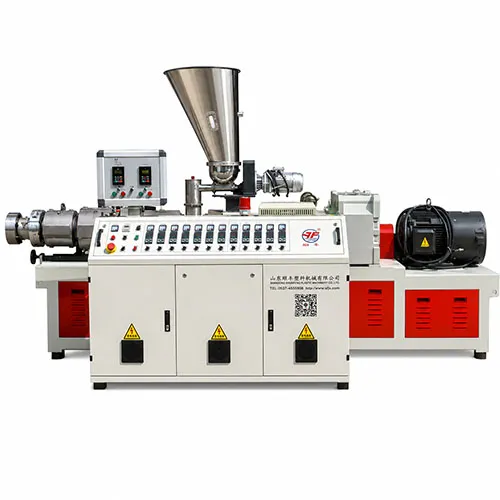
A conical twin screw extruder is a twin screw extruder machine with two conical screws working inside a heated barrel. It is commonly used for PVC powder processing, PVC pipe extrusion, PVC profile production, PVC sheet, WPC, and pelletizing lines because it supports stable conveying, mixing, plasticizing, and extrusion pressure.
What Is a Conical Twin Screw Extruder?
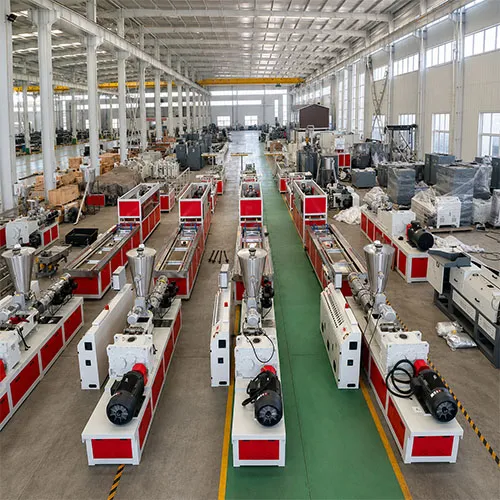
A conical twin screw extruder is a plastic extrusion machine that uses two conical twin screws to move, mix, heat, plasticize, and push PVC or other thermoplastic materials through a die. The screws are wider at the feeding end and narrower near the die end, which gives the machine strong feeding ability and stable pressure.
This type of twin screw extruder is widely used in PVC pipe, PVC profile, PVC sheet, WPC profile, PVC foam board, and PVC pelletizing applications. It is also called a conical twin-screw extruder, conical double screw extruder, PVC extruder, or conical twin screw extruder machine.
For B2B buyers, the machine is not only one piece of machinery. It is the heart of a full extrusion line. The extruder must match the screw and barrel, die head, vacuum calibration tank, cooling tank, haul-off, cutter, stacker, pelletizing system, or other downstream auxiliary machines.
In simple words, the conical twin screw extruder helps turn PVC powder or compound into stable products with a continuous shape.
How Does a Conical Twin Screw Extruder Work?
The process starts with feeding. PVC powder, stabilizer, filler, colorant, lubricant, and other additives enter the hopper. The twin screws rotate inside the barrel and move the material forward. Heat, pressure, and screw movement support mixing and plasticizing.
In many PVC applications, the twin screws are counter-rotating. This means the screws rotate in opposite directions. The material moves through the gap between the screw flight and barrel, where it is compressed, mixed, heated, and pushed toward the die.
A basic extrusion process includes:
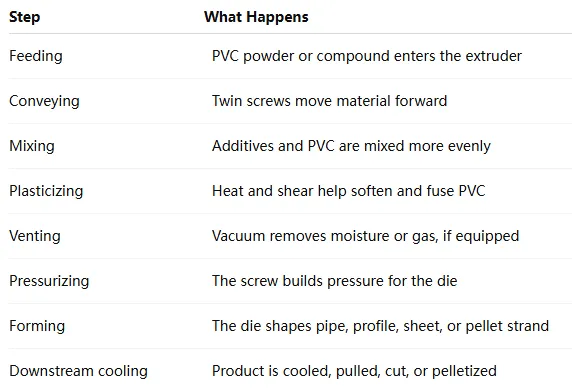
The goal is stable melt quality. If the screw speed, barrel temperature, shear rate, die pressure, or residence time is wrong, PVC products may show bubbles, poor surface, burning, weak strength, or unstable dimensions.
Why Is a Conical Twin Screw Preferred for PVC?
PVC is sensitive to heat. It needs good mixing and stable plasticizing, but it does not like excessive shear or long residence time. That is why a conical twin screw extruder is often preferred for PVC powder and rigid PVC processing.
PVC is commonly processed as powder, not only as pellet. A good twin screw extruder for PVC can feed powder more reliably than many simple systems. The conical screw structure also supports strong conveying at the feeding section and stable pressure near the die.
The main benefits for PVC include:
- Stable feeding of PVC powder
- Better mixing of additives and stabilizers
- Good plasticizing with controlled shear
- Strong extrusion pressure for die forming
- Suitable for PVC pipe and PVC profile production
- Good support for continuous production line operation
- Practical matching with downstream pipe or profile equipment
A conical twin screw is especially useful when buyers want a PVC pipe production line, PVC profile extrusion line, WPC profile line, or PVC sheet extrusion line. The machine can help improve product quality when it is selected and set correctly.
What Are the Main Components of a Twin Screw Extruder Machine?
A twin screw extruder machine includes several core parts. Each part affects extrusion stability, output, quality, and maintenance. A weak part can limit the whole production line.
Main components include:
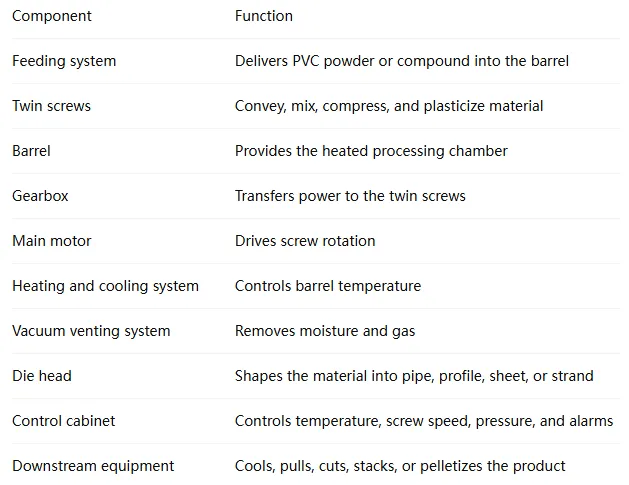
The screw and barrel are the key wear parts. For PVC, the screw configuration should support stable feeding, gentle mixing, and controlled pressure. The barrel should provide accurate temperature control and long working life.
A reliable plastic extruder machine must also be easy to maintain. Overseas buyers should confirm spare parts, screw barrel supply, remote support, and troubleshooting service before ordering.
Conical Twin Screw vs Parallel Twin Screw Extruder: What Is the Difference?
The differences between parallel and conical twin screw extruder systems are important for buyers. Both can process PVC, but their structure and performance are different.
A conical twin screw has screws that are larger at the feeding end and smaller near the die end. This structure gives strong feeding and compact machine design. A parallel twin screw has screws with the same diameter along the process section.
Simple comparison:
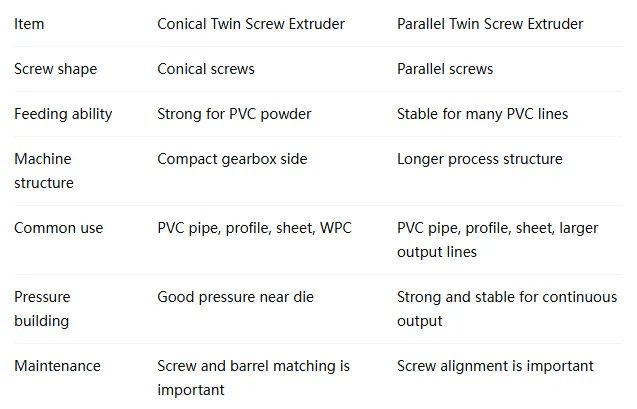
A parallel twin-screw extruder may be suitable for higher-output PVC pipe extrusion or large production lines. A conical twin screw extruder is often a practical choice for small to medium PVC pipe profile granules sheet applications.
For buyers, the better option depends on product type, expected output, process conditions, factory layout, and investment plan.
Conical Twin Screw Extruder vs Single Screw Extruder: Which Is Better?
A single screw extruder uses one screw. It is simple, economical, and widely used for PE, PP, film, pipe, sheet, and profile production. Single screw extrusion works well for many plastic materials that come as pellets or easy-flowing granules.
A conical twin screw extruder uses twin screws. Compared to single screw extrusion, twin screw systems usually provide stronger feeding, better mixing, and more stable PVC powder processing. This is important for PVC because the material often needs additives and careful temperature control.
A single screw extruder may be suitable for PE or PP pipe extrusion. A conical twin screw extruder for PVC pipe or profile is usually the better choice when processing PVC powder and rigid PVC formulations.
What PVC Products Can a Conical Twin Screw Extruder Produce?
A conical twin screw extruder can be used in many PVC extrusion lines. With the right die and downstream equipment, it can produce pipe, profile, sheet, board, pellet, or WPC products.
Common applications include:
- PVC pipe
- PVC conduit
- PVC profile
- PVC door and window profile
- PVC sheet
- PVC foam board
- WPC profile
- PVC ceiling panel
- PVC cable trunking
- PVC granules
- PVC pelletizing
- PVC pipe profile granules sheet production
A PVC pipe extrusion line usually includes a conical twin screw extruder, pipe die, vacuum calibration tank, cooling tank, haul-off, cutter, and stacker. A PVC profile extrusion line may include a profile die, calibration table, cooling system, haul-off, cutter, and stacker.
A PVC pelletizing line may use a die, cutter, cooling, and collection system. The extruder provides plasticizing and pressure, while downstream equipment decides final product shape and handling.
This is why buyers should not only select the extruder. They should plan the full extrusion line.
How Should Buyers Choose a Conical Twin Screw Extruder Machine?
Choosing the right conical twin screw extruder machine starts with the final product. Buyers should not only ask for the lowest price. They should confirm material, product size, output target, die type, downstream line, automation, and service.
Before requesting a quote, prepare these details:
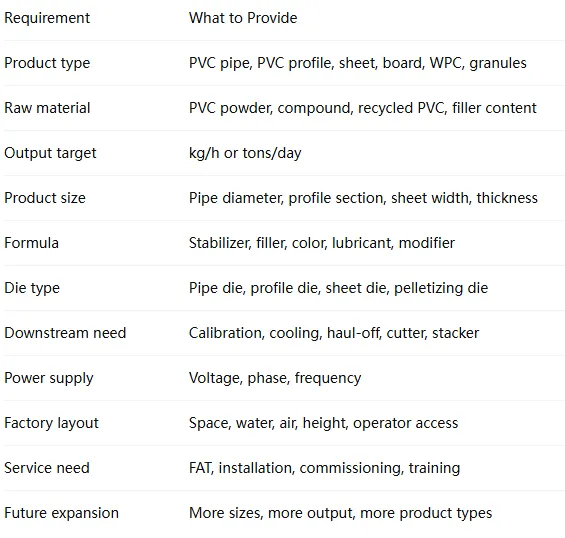
A good extruder manufacturer should ask questions before giving a final proposal. This is not delay. It is how a supplier protects your investment.
For global buyers, a practical proposal should include equipment configuration, output estimate, delivery schedule, spare parts list, installation plan, operator training, and after-sales support.
How Can a One-Stop Plastic Machinery Supplier Support PVC Extrusion Projects?
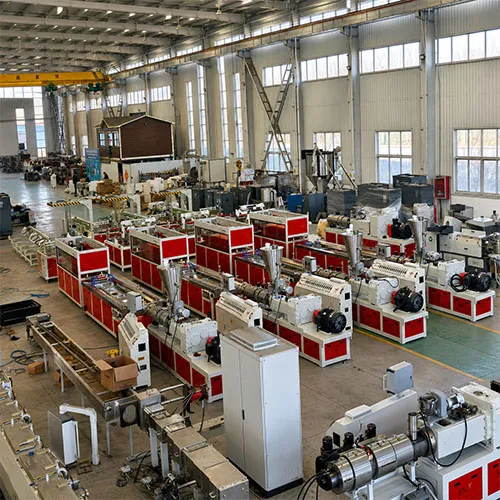
A one-stop plastic machinery supplier can help buyers reduce risk. PVC extrusion is not only the extruder. A complete production line includes mixing, feeding, extrusion, die forming, vacuum calibration, cooling, haul-off, cutting, stacking, pelletizing, or packing.
As a factory-direct, engineering-driven supplier, we serve global B2B customers with one-stop plastic machinery solutions, including injection molding, extrusion, film blowing, pelletizing, equipment support, turnkey delivery, and full lifecycle service.
We can support:
- Conical twin screw extruder selection
- PVC extruder line planning
- Screw and barrel matching
- PVC pipe extrusion line configuration
- PVC profile extrusion line planning
- Die and downstream equipment matching
- Auxiliary machines selection
- Process support for PVC formula and production
- FAT antes del envío
- Documentación conforme a la normativa de exportación
- Apoyo logístico internacional
- Instrucciones de instalación y puesta en marcha
- Formación de operadores
- Suministro de piezas de recambio
- Resolución de problemas a distancia
- Programas de mantenimiento
For overseas buyers, this support is important. Owners want clear investment cost. Project managers need delivery milestones. Engineers want stable extrusion. Maintenance teams need spare parts and service.
A good supplier should help customers reach stable production, not only ship machinery.
Preguntas frecuentes
What is a conical twin screw extruder used for?
A conical twin screw extruder is mainly used for PVC pipe, PVC profile, PVC sheet, WPC profile, PVC foam board, and PVC pelletizing production. It is suitable for processing PVC powder and compounds.
Why is a conical twin screw extruder good for PVC?
PVC is heat-sensitive and often processed as powder. A conical twin screw extruder provides strong feeding, good mixing, stable plasticizing, and controlled extrusion pressure, making it suitable for many PVC products.
What is the difference between conical twin screw and parallel twin screw extruder?
A conical twin screw extruder uses screws that are larger at the feed end and smaller near the die end. A parallel twin screw extruder uses screws with the same diameter. Both can process PVC, but their structure, output range, and application fit may differ.
Is a twin screw extruder better than a single screw extruder?
For PVC powder processing, a twin screw extruder is usually better because it offers stronger feeding and mixing. A single screw extruder is often better for standard PE, PP, and pellet-based extrusion applications.
What products can a conical twin screw extruder produce?
With the correct die and downstream equipment, it can produce PVC pipe, PVC conduit, PVC profile, PVC door and window profile, PVC sheet, PVC foam board, WPC products, and PVC granules.
What information is needed for a conical twin screw extruder quote?
Buyers should provide product type, PVC formula, output target, product size, die type, downstream equipment needs, factory layout, power supply, automation level, and service requirements.
How can a supplier support PVC extrusion line projects?
A supplier can help with machine selection, screw and barrel matching, die and downstream equipment planning, FAT, export documentation, installation, commissioning, training, spare parts, remote support, and maintenance programs.


 2026-07-17-16:48
