

Comment choisir la presse à injection adaptée à votre moule en plastique et à votre usine
Buying the wrong injection molding machine can lead to flash, unstable cycles, wasted ener…
17 août 2026
 2026-08-17-10:59
 Buying the wrong injection molding machine can lead to flash, unstable cycles, wasted energy, difficult mold installation, and costly production delays. The problem gets worse at mass-production scale. To avoid this, you need to match the machine to your mold, plastic material, output target, and future production plan.
To choose the right machine de moulage par injection, first confirm the mold dimensions, projected molding area, required clamping force, shot size, plastic material, injection speed, and production volume. Then compare hydraulic, electric, and hybrid machines. The best machine is not simply the largest press; it is the one that gives your mold enough capacity, control, repeatability, and room for reliable mass production.

Choosing an injection molding machine looks simple when you compare specification sheets. In practice, it is an engineering decision. A machine may have enough tonnage but too little shot capacity. It may have enough injection volume but insufficient tie-bar spacing for your mold. Or it may produce acceptable samples while using too much energy during 24-hour production.
For global B2B factories, these details affect much more than the purchase price. They affect cycle time, yield, labor, maintenance, delivery schedules, and whether future molds can run on the same machine.
At HEE&HATO, we approach equipment selection from the production requirement backward. Our injection molding portfolio sits within a wider one-stop plastics machinery system that includes injection molding, extrusion, film blowing, pelletizing, screw and barrel solutions, process support, commissioning, training, and after-sales service. HEE&HATO publicly positions its equipment business around factory-direct supply, standardized quality control, energy-saving solutions, controllable delivery, and turnkey service.
Start with the mold, not the machine catalog.
Before asking a supplier for a quotation, collect the basic mold information:
These parameters tell us whether the mold can physically fit inside the press and whether the machine can run it safely.
A common mistake is to select an machine de moulage par injection based mainly on part weight. But the molded part may be small while the mold base is large. In another project, the mold may fit between the tie bars, but the required opening stroke may exceed the machine’s available movement.
The mold must work with the machine’s platen, tie bars, locating ring, nozzle position, ejector arrangement, and clamp stroke.
HEE&HATO’s injection molding catalog reflects this selection logic by presenting machine comparison around specifications such as tonnage, shot volume, platen, and stroke rather than treating machine size as one number.
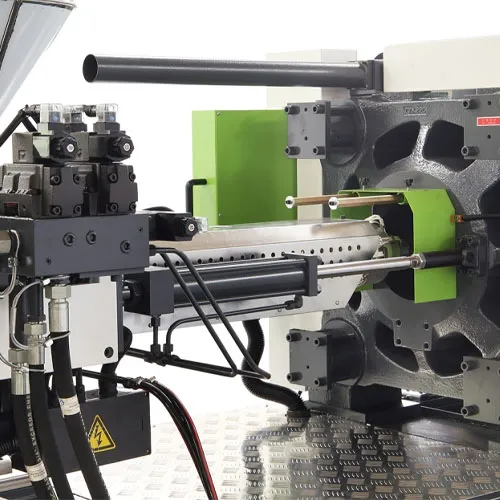
Before selecting a machine, ask one simple question:
Can this mold fit, close, inject, open, eject, and run repeatedly on this machine?
If any part of that answer is uncertain, the selection is not finished.
The clamping force keeps the mold closed while molten plastic fills the cavity under pressure.
This is one of the most important parameters when you select an injection molding machine.
During injection, the molten material creates pressure inside the mold cavity. That pressure tries to push the two mold halves apart. The clamp must provide enough force to prevent unwanted mold opening and flash.
A practical engineering estimate usually considers:
Required clamp force ≈ projected area × expected cavity pressure
The exact calculation depends on material, mold design, flow length, wall thickness, gate system, cavity count, and processing conditions. RJG’s technical guidance likewise stresses that the available clamp force must be sufficient to keep the mold closed against pressure developed in the mold cavities and runner system.
Do not simply choose the highest machine tonnage you can afford.
A machine with too little clamp capacity can cause:
But unnecessarily higher clamping capacity also has drawbacks. It can mean a larger machine, higher capital cost, more floor space, and potentially higher operating costs.
Suppose two molds make products of similar weight. One is a thick industrial fitting. The other is a wide thin-wall food container. Their required injection molding machine tonnage can be very different because their projected areas and cavity pressures are different.
That is why you should calculate the mold requirement rather than selecting the press from product weight alone.
Once the clamp side works, check the shot size.
Shot size is the quantity of molten plastic that the machine’s injection unit can deliver during one cycle. Your required amount includes more than the final product.
You may need to count:
Total shot requirement = molded part weight × cavity count + runner material
For a hot-runner mold, runner waste may be small. For a cold-runner system, the runner can significantly increase the required shot volume.
The important point is simple: do not select an injection machine whose maximum capacity is almost identical to your theoretical part requirement.
The machine needs a practical operating window.
For example, imagine a four-cavity mold producing four 120 g parts. The parts alone require:
4 × 120 g = 480 g
If the cold runner weighs 50 g, the real shot requirement becomes about:
530 g per cycle
Material density and machine specifications also matter, so weight alone should not be used blindly when comparing equipment. Technical machine-selection guidance commonly evaluates shot capacity together with material density and mold requirements.
You also need to consider future molds.
A slightly more versatile machine may make sense if your factory plans to use several similar molds. But going far beyond your real production requirements can create unnecessary cost.
When we assess a project, we want enough capacity for stable production without turning excess machine size into idle investment.
There is no single machine technology that is best for every factory.
The main decision often comes down to hydraulic, electric, or hybrid injection technology.
Traditional hydraulic machines use hydraulic power for machine movements.
They remain useful across many general-purpose and higher-force applications. Modern servo-hydraulic designs can also reduce unnecessary energy use compared with older fixed-pump systems.
Un electric injection molding machine uses electric servo motors to control major movements.
Electric systems are often considered where factories value clean operation, accurate motion control, repeatability, and energy efficiency.
Hybrid systems combine elements of hydraulic and electric technology.
They can be useful when a buyer wants certain electric-control advantages while retaining hydraulic functions for other parts of the production process.
| Machine Type | Typical Purchasing Priority |
|---|---|
| Hydraulic | Flexible general production and strong force capability |
| Electric | Precision, repeatability, clean production, and energy control |
| Hybride | Balance between control, performance, and application needs |

Make it a production decision.
For medical packaging or high-precision components, dimensional accuracy and repeatability may dominate the discussion. For larger industrial products, the mold, clamp requirement, and production economics may lead to a different answer.
HEE&HATO’s catalog includes servo-hydraulic and all-electric injection molding solutions and positions equipment selection around specific manufacturing needs rather than one drive technology.
Injection speed controls how quickly molten material enters the cavity.
This becomes very important for thin-wall products.
When the wall is thin, molten plastic loses heat quickly as it touches the cooler mold. The machine may need to inject fast enough to fill the cavity before the flow front freezes.
However, faster is not automatically better.
Too much injection speed and pressure can contribute to problems such as:
The correct profile depends on the mold, gate, resin, wall thickness, flow length, and target cycle.
Academic research into injection molding confirms that changing parameters such as injection speed can materially affect melt-flow behavior and resulting surface conditions.
For thin-wall food packaging, this relationship becomes especially important. A mold with several cavities needs rapid and balanced filling while still protecting part quality.
For thicker industrial parts, the ideal injection profile can look very different.
So when a supplier asks for the product drawing, material, wall thickness, mold layout, and target cycle time, that is not extra paperwork. Those inputs help determine the correct injection performance.
A machine that can make one good sample is not necessarily a good mass-production machine.
Production volume changes the purchasing decision.
Suppose you need 100,000 parts per year. Cycle time matters, but equipment utilization may be moderate.
Now suppose you need 20 million parts per year.
Small changes in:
can have a major financial impact.
This is why we advise buyers to define the real production needs before they select a machine.
A useful production estimate is:
Annual theoretical output = cavities × cycles per hour × operating hours
Then reduce that number to account for actual plant availability, planned maintenance, mold changes, quality checks, material changes, and other real production conditions.
For high-volume plastic injection molding, stable cycle times are often more valuable than achieving one very fast demonstration cycle.
The goal is repeatable output.

For HEE&HATO’s target applications, this matters especially in food packaging, medical solutions, automotive components, and industrial parts. The company’s application structure emphasizes repeatable processing, quality control, traceability, and stable production rather than equipment supply alone.
The machine is only one part of the line.
One of the biggest mistakes in purchasing an injection molding system is budgeting for the press while treating every supporting system as an afterthought.
Your project may also need:
These systems affect the overall molding process.
For example, a highly accurate press cannot compensate for unstable material drying. A fast injection machine cannot meet its cycle target if cooling capacity is insufficient.
That is why the most useful injection molding machine supplier is often the one that understands the whole production cell.
HEE&HATO publicly describes its business as a one-stop plastics machinery solution covering equipment selection, delivery, commissioning, training, and after-sales service. Its wider product portfolio also includes extrusion systems, film-blowing equipment, pelletizing systems, and screw/barrel solutions.
For an EPC contractor, system integrator, distributor, or factory expansion manager, this can simplify technical coordination.
How do I know what injection molding machine tonnage I need?
Start with the projected area of the product and runner system, then estimate the expected pressure inside the mold. The required clamping force must be enough to keep the mold closed during filling and packing. Material, wall thickness, geometry, cavity count, and processing conditions should also be considered.
Should I choose a larger injection molding machine for safety?
Not automatically. Oversizing can increase purchase cost, floor-space use, and operating cost. The right choice is a machine with a suitable working margin around your actual mold and process requirements. Larger does not always mean more suitable.
How do I calculate the required shot size?
Add the total weight or volume of all parts produced in one cycle and include runner material where applicable. Then consider resin density and a practical operating margin. Do not match the calculated requirement directly to the machine’s absolute maximum injection capacity.
Is an electric injection molding machine better than a hydraulic machine?
It depends on your application. Electric equipment can be attractive for precision, clean production, repeatability, and energy control. A hydraulic system may be a practical option for many general or high-force applications. Hybrid designs provide another set of machine options. Evaluate the product, mold, production target, and total ownership cost before selecting the right technology.
Can one injection machine run several different molds?
Yes, if those molds all fall within the machine’s clamp, injection, platen, mold-height, stroke, and material-processing capability. If your factory expects frequent product changes, tell the supplier about all planned molds before choosing the right machine.
What information should I send before asking for an injection molding machine quotation?
At minimum, send the product drawing, product weight, material, cavity count, mold dimensions, target cycle, annual production requirement, automation needs, and local electrical specifications. If the mold already exists, send the mold drawing as well. This allows the supplier to recommend the right injection molding machine instead of guessing.

Buying the wrong injection molding machine can lead to flash, unstable cycles, wasted ener…
Choosing the wrong extrusion machine can cause unstable output, poor product size, high wa…
Nous vous répondrons dans les 24 heures. En cas d'urgence, veuillez ajouter WhatsApp/WeChat : +86 15653430206,. Ou appelez directement +86 15653430206.
*Nous respectons votre confidentialité et toutes les informations sont protégées.
Nous n'utiliserons vos informations que pour répondre à votre demande et n'enverrons jamais de messages électroniques ou promotionnels non sollicités.